

“Forgetting” after an exam might not be a bad thing
– Written by: Dr. Claudio Violato –
Before The Renaissance
Prior to systematic testing as in modern times, the licensing of physicians has nevertheless been regulated. Control of the medical market place through licensing, prosecutions and penalties has a long history and is not unique to modern society. Several cases illustrate the practices in the past several hundred years.
Jacoba Felicie paced nervously in her room glancing through her notes a final time before she set out for the court house [1]. Powerful forces including the Dean and Faculty of Medicine at the University of Paris were allied against her. This was Paris in 1322 and the physician guilds and university faculty had increased in power and control of the medical marketplace. They were seeking to consolidate their regulation of medical practice. They decided that Jacoba was a particularly good case to prosecute as she was a woman practicing medicine. The Dean and Faculty of Medicine were determined to put a stop to the illegal practice of medicine.
For some time now the Parisian faculty wanted to gain stronger control over various practitioners of medicine such as surgeons, barbers and empirics whether male or female. The Dean and the Faculty of Medicine charged Jacoba with illegally visiting the sick, examining their limbs, bodies, urine and pulse, prescribing drugs and collecting fees. The Dean and Faculty were most outraged because she actually cured some patients, frequently after conventional physicians had failed to do so.
The Dean and Faculty of Medicine who prosecuted her did not deny her  skill or even that she cured patients. They argued that Jacoba had not read the proper texts; medicine was a science to be acquired through proper reading of texts such as Galen and lectures and discourse based on the written word. Medicine was not a craft to be learned empirically.
Jacoba argued in court that the intent of the law was to forbid the practice of medicine by ignorant and dangerous quacks and charlatans but that this did not apply to her as she was both knowledgeable and skilful. She also argued that she was fulfilling a particular need with female diseases because conventional modesty precluded male practitioners from dealing with these. Many of Jacoba’s patients came to court that day to testify to her skill, knowledge and caring. Jacoba must have been crushed when the court ruled in favor of the Dean and Faculty of Medicine that she was not legally constituted to practice medicine in Paris. She was therefore prohibited from practicing medicine in the future on penalty of imprisonment. The court acknowledged her patients’ positive testimonies, but this was not deemed relevant to her legal status as a medical practitioner. Thus the case of Jacoba ended and we have no further historical record of her. Perhaps she left Paris to practice medicine.
The French medical establishment continued to do battle with illegal practitioners of medicine including the famous skirmishes with Louis Pasteur in the mid-19th century [2], some 500 years after the case of Jacoba. One incensed physician even challenged Pasteur to a duel. Louis Pasteur, primarily a chemist and microbiologist, is one of the main founders of the germ theory of disease. Although his discoveries reduced mortality from puerperal fever, created the first vaccine for rabies and anthrax, and eventually revolutionized medical practice, the medical establishment in France was hostile to him as an unlicensed interloper.
The Renaissance and the Case of Leonardo Fioravanti
The Milanese physicians had been plotting against him since his arrival from Venice in 1572. Fioravanti had been arrested and imprisoned by officers of the Public Health Board in Milan on the sketchy charge of not medicating in the accepted way [3]. After eight days in prison Fioravanti was becoming increasingly outraged by the indignity he was suffering. The Milan medical establishment considered him an outsider, an alien and an unwelcome intruder. They finally were able to have him incarcerated.
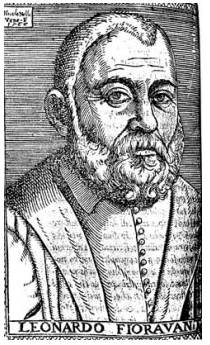
Fioravanti was not a conventional medical charlatan hawking his nostrums in the piazza and then moving on. Nor was he a run-of-the-mill barber-surgeon. He had practiced medicine for years in Bologna, Rome, Sicily, Venice and Spain. He had a MD from the University of Bologna, had published several medical texts, had developed many medicines, and was a severe critic of much of conventional medical practice. The Milan physicians were not welcoming and considered him a foreign doctor.
A prison guard provided pen-and-paper for Fioravanti, and in his most elegant and formal language, he addressed it to Milan’s public health minister from “Leonardo Fioravanti of Bologna, Doctor of Arts and Medicine, and Knight”. He asked to be released from prison and to “medicate freely as a legitimate doctor”. A paid messenger delivered the letter to the Health Office located in the Piazza del Duomo.
The health minister, Niccolo Boldoni, was responsible for overseeing every aspect of medical practice in Milan, from examining midwives, barber-surgeons, and physicians, to collecting fees, imposing fines, inspecting apothecaries, and ruling on appeals. The letter from the Doctor and Knight, Leonardo Fioravanti, claimed that the Milan physicians were in a plot to stop him from providing care and cures to the sick of Milan. Moreover, he claimed that the Milan physicians were a menace to their patients and did more harm than good with quack treatments, poisonous medicines, and careless and arrogant behaviors. Fioravanti challenged the minister to provide 25 of the sickest patients to him and an equal number to Milan doctors that the minister selected and that he – Fioravanti – would cure his patients quicker and better than the other doctors. It is unlikely that this early clinical trial ever occurred as there is no historical record of it, but Boldoni and the Milan court set Fioravanti free.
Sources:
[1] Magner, LN (2005). A History of Medicine (2nd edition). New York: Taylor & Francis, p. 154-155
[2] Debre P (2000). Louis Pasteur. Baltimore, MD: Johns Hopkins University Press.
[3] Eamon W (2010). The Professor of Secrets. Washington, DC: National Geographic Publishing.
Related posts


